
Why Proactive Habit Still Defines Great Leadership
When I had the chance to attend a leadership programme based on Stephen Covey's The 7 Habits of Highly Effective People back in 2016, I fell in love with the content almost immediately — and of all seven habits, the one I have come to believe is most important for any people manager is the very first: Be Proactive.
If you have ever observed a manager who constantly blames everything except himself — who keeps insisting "I can't do this" or "there's nothing I can do about that" — you already know what is happening. That manager has, often without realising it, chosen a perspective in which the situation manages him, rather than the other way around. And once that perspective sets in, no training programme, no new title, and no organisational restructure will fix it. Only a different mindset will.
This article is my attempt to set out, in plain language and from a working consultant's perspective, why this single habit matters so much for those of us who lead people — and how to actually build it.
What "Proactive" Actually Means
The word has been worn thin by corporate use. Managers today talk about being "proactive about deadlines" or "proactive about risks" as if the word were just a more energetic synonym for early or eager. That is not what is meant here.
To be proactive, in the deeper sense, is to recognise something that most of us forget under pressure: between what happens to us and how we respond, there is a space. That space — small, often invisible, sometimes only a heartbeat wide — is where our freedom as human beings actually lives. People who behave reactively surrender that space. They allow circumstances, moods, other people's behaviour, and the temperature of the day to dictate their response. People who behave proactively defend that space and use it, deliberately, to choose what comes next.
The principle has deep roots. Viktor Frankl, the psychiatrist who survived the Nazi concentration camps, wrote that even when everything else had been stripped from a human being — possessions, family, dignity, freedom of movement — one final freedom remained: the freedom to choose one's response to what was happening. If that freedom existed in such conditions, it certainly exists in a Monday morning meeting.
Proactivity, then, is not really about pace or energy. It is about the ability to respond rather than merely react — the conscious refusal to be a thermometer that simply registers the temperature of the room, and the deliberate choice to be a thermostat that helps set it.
The Inner Capacities That Make It Possible
What makes a proactive response possible at all? In my experience training and coaching managers, four inner capacities tend to do most of the work:
Self-awareness — the ability to step back from your own thinking and watch it as if from a slight distance. Without this, you cannot even notice that you are about to react badly.
Imagination — the ability to picture a different response, a different outcome, a different version of the conversation than the one currently unfolding.
Inner principles — a working sense of what you actually believe is right, fair, and worth standing for. Without this, every choice gets pulled toward the easier option.
Will — the capacity to act on what self-awareness, imagination, and principles tell you, even when mood and circumstance are pulling in the opposite direction.
A manager who exercises these four capacities stops being a passenger in their own working life. They notice when frustration is about to drive a comment they will regret. They imagine how a difficult conversation could go differently, and they prepare for it. They feel the small dishonesty of nodding along with something they do not actually believe in. And they act, with their will, on the harder right rather than the easier wrong.
A manager who has not built these capacities — regardless of seniority, salary, or job title — is at the mercy of every email that arrives, every mood the boss is in, and every disappointment the team delivers.
Listen to the Language
One of the most practical diagnostics I have ever encountered is simply to listen to a manager's language. The words people use are not just descriptions of how they feel; they are quiet reinforcers of how they think. Every reactive sentence makes the next reactive thought a little easier to reach for. Repeat the pattern long enough and it stops being a way of speaking — it becomes a way of being.
Compare these everyday workplace phrases:
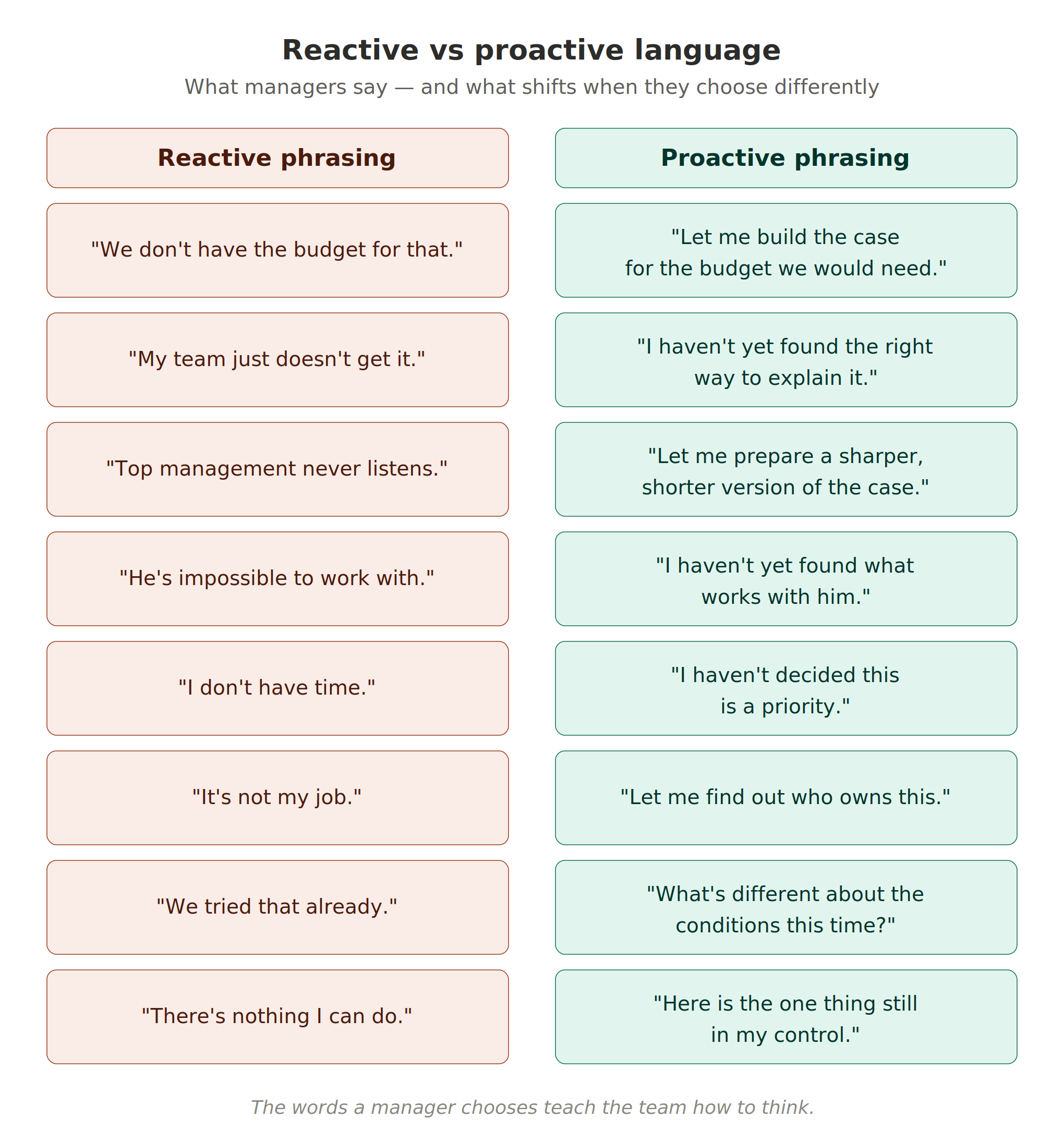
Read the left-hand column again and ask yourself honestly: how many of those have you heard from managers in your organisation in the last month? How many have you said yourself?
The language is contagious. A manager who says "the company won't let us" trains the team to think the same way, and the team, in turn, says it to one another in corridors and on Teams calls. A manager who says "let's see what is actually within our control here" trains a different reflex entirely. Over time, people begin to look for what they can do before declaring what they cannot.
This is not positive thinking dressed up as a leadership habit. It is intellectually honest leadership. The proactive manager does not pretend constraints do not exist — they simply refuse to stop thinking the moment a constraint appears.
Where Your Energy Actually Goes
Here is the idea that, in my workshops and coaching sessions, I find managers come back to most often. It is also the one that produces the fastest visible change in behaviour when taken seriously.
Imagine two concentric circles.
The outer circle is everything you care or worry about: economic conditions, head office politics, your CEO's mood, what your competitors are launching, the regulatory environment, your child's school grades, the weather on the day of your team's outdoor event. It is wide and full of important things. It contains most of what occupies your mind during the workday.
The inner circle is much smaller. It contains only the things you can actually act on: your own attitude, your preparation for tomorrow's meeting, the conversation you have been avoiding with one of your direct reports, the report you said you would send and have not yet sent, the feedback you owe someone, the half-hour of focused thinking you keep promising yourself.
Here is the pattern I have watched play out for fifteen years of consulting:
Managers who pour their energy into the inner circle find that, over time, that circle gets bigger. Their preparation, follow-through, and visible competence earn them influence over things they used to merely worry about. Managers who pour their energy into the outer circle — complaining, narrating, blaming, anxiously discussing — find that the inner circle quietly shrinks. They become less and less effective at the very things they were once trusted to deliver.
A reactive manager spends Monday's leadership meeting frustrated about head office decisions, bonus pool sizes, and what marketing did or did not do. By Friday, they are exhausted, and the team is no further forward. A proactive manager registers all those same constraints, sets them aside, and asks: given that none of those things will change this week, what conversation, decision, or piece of preparation that I can actually do today would move us forward?
Twelve months of this discipline, and the two managers occupy entirely different positions in the organisation. The proactive one is now sitting at tables they used to complain about being excluded from — because they have built the credibility, relationships, and track record that earn the seat.
The Multiplier Effect
What makes this habit especially urgent for people managers — as distinct from individual contributors — is the multiplier effect.
A reactive analyst diminishes their own output. A reactive manager diminishes the output, mood, and developmental trajectory of every person they lead.
Teams unconsciously calibrate to their manager. If the manager catastrophises every setback, the team learns to hide setbacks. If the manager blames upward in private, the team learns that blame is acceptable currency. If the manager waits for permission before acting, the team learns to wait too. If the manager treats every problem as someone else's fault, the team adopts that posture as the default operating mode.
The reverse is just as true. A manager who consistently demonstrates the pause between stimulus and response — who treats every problem first as a question of "what can we do?" rather than "whose fault is this?" — gradually creates a team that mirrors the same pattern. Not because of any motivational speech or kick-off poster, but because that is simply how the team has learned the work gets done around here.
This is why proactivity is not optional for those of us who manage people. You are always teaching, whether you intend to or not. The only honest question is: what are you teaching?
Five Practical Disciplines
Concept is cheap; behaviour is what changes outcomes. From years of training and coaching managers across Malaysia and the wider region, here are the five proactive disciplines that I have seen most reliably distinguish strong people managers from those who continue to struggle.
1. Build the pause. When something difficult happens — a complaint, a missed target, a sharp message from a peer — do not respond in the same minute. Walk to the window. Make a cup of teh tarik. Re-read the message tomorrow before you reply. The pause is not avoidance; it is the small window in which all four inner capacities have a chance to do their work. Most regrettable management decisions are made within sixty seconds of the trigger.
2. Audit your own language for one week. Listen to yourself in meetings, in WhatsApp messages, in corridor conversations. Quietly count the reactive phrases — I have to, they won't let me, there's no way, that's just how it is. You cannot change a habit you have not first noticed. Once the noticing begins, the language tends to start correcting itself.
3. Run an honest review of last week's diary. Open your calendar from the past five working days and ask yourself: how much of that time was spent on things genuinely within my control? How much was spent worrying about, complaining about, narrating, or being upset over things I could not change anyway? Most managers, when they answer honestly, find a 30/70 split — and an unmistakable signal of where the next month's discipline must be focused.
4. Hold the team to proactive language too. When a team member says "finance will never approve that," gently rephrase it back: "so the constraint is finance's current criteria — what would a proposal look like that meets those criteria?" You are not being pedantic; you are training a habit of mind. Done consistently for a few months, this single intervention can change the operating temperature of a whole team.
5. Be the climate, not the weather. A manager whose mood, tone, and presence visibly rise and fall with every passing event teaches the team to read the manager rather than read the work. Your team should not need to study your face every morning to know what kind of day they are in for. Your internal state, over time, should be governed by your values and choices — not by the last email you opened. This is one of the highest forms of leadership presence, and almost nobody is taught it explicitly.
The Cost of Reactive Management
It is worth being honest about the cost of getting this wrong, because reactive management is rarely punished directly. The reactive manager often has perfectly acceptable performance reviews. The damage shows up elsewhere, in places that do not appear on any performance scorecard.
It shows up in the team member who quietly stops bringing forward ideas because the last three were dismissed in frustration. In the high-potential who declines a stretch role because they have watched the manager handle pressure and concluded "I do not want that life." In the slow erosion of trust that means difficult conversations are postponed until they absolutely cannot be postponed any longer, by which point they are far too late and far too damaging. In the manager's own health, sleep, and family relationships, which are usually the first to absorb the cost of a working life lived at the mercy of every incoming stimulus.
These costs do not appear on any P&L. But they are real, and they compound, and at some point in a manager's career they come due — sometimes all at once.
A Closing Thought
Of all the habits in Covey's framework, this one is listed first for a structural reason and not an arbitrary one. Every other habit that follows depends on it.
You cannot meaningfully set a long-term direction for yourself or your team if you do not believe you have any agency over the direction in the first place. You cannot prioritise well if your day is governed entirely by other people's urgencies. You cannot collaborate genuinely, listen well, or build trust from a posture of victimhood, blame, and circumstance. Proactivity is the foundation that the rest of leadership development is built on.
It is not glamorous. It does not photograph well for LinkedIn. It does not get celebrated in awards ceremonies or written up in case studies. But it is the daily, unspectacular, often invisible discipline that — over the span of a career — separates the manager who shapes their environment from the manager who is shaped by it.
For people managers, whose work is, by definition, the development of other human beings, that distinction is not a nice-to-have. It is the work itself.
Reflection questions for you: -
When something difficult lands in front of me, where do I tend to look first — at what is in my control, or at what is outside it?
What reactive phrases do I use most often, and what are they teaching the people who report to me?
If I audited last week's diary, what proportion of my time was spent on things I could actually act on, versus things I could only worry about?
What kind of climate do I bring into the room when I walk in — and is it the climate I would want to work under, if I were on the other side of the table?