Why Modern Talent Management Calls for T-Shaped Competencies?
According to Gartner, 70% of CEOs now expect their CHRO to be a key player in enterprise strategy. Yet only 55% report that their CHRO is actually meeting that expectation. That fifteen-point gap is not a survey footnote. It is the precise cost of HR professionals who remain too narrowly specialised to contribute at the level the business now demands.
Closing that gap is exactly what the T-Shaped Competency Model exists to do. Before we unpack why it has become the defining capability blueprint for the modern Talent Management Professional, we need to clear up a foundational confusion that quietly stalls many HR careers.
The Foundation: Competence Is Not the Same as Competency
In everyday HR conversation, “competence” and “competency” are used interchangeably. In serious talent strategy work, conflating them is a costly mistake. They measure fundamentally different aspects of a professional’s capability, and high-performing practitioners learn to engineer both with precision.
Competenceis the what. It is a skill-based standard—the proven ability to perform a specific task successfully. Competence tends to be binary: you either know how to configure an Applicant Tracking System, or you do not. You either understand the legal requirements of a Malaysian employment contract under EA 1955, or you do not.
Competency is the how. It encompasses the mindsets, behaviours, emotional intelligence, and cognitive habits that drive outstanding performance. Competencies determine how a practitioner applies their skills to solve complex, unpredictable, business-critical problems. A practitioner with strong “Business Acumen” does not just process a hiring requisition—they recognise that a new product launch will demand entirely different candidate profiles, and they proactively redesign the recruitment strategy to match.
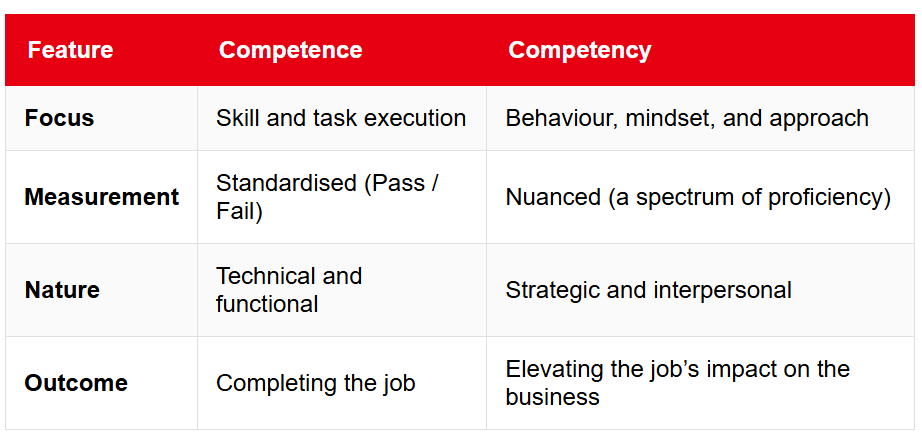
Once you internalise this distinction, the case for the T-Shaped Model becomes self-evident. Skills alone produce reliable executors. Competencies are what produce strategic partners.
Why Specialist HR Knowledge Alone Is No Longer Sufficient
Consider a talent acquisition specialist working inside a mid-sized organisation. Traditionally, the role centred on sourcing candidates, managing interview pipelines, and extending offers. That work has not disappeared—but it now accounts for only a fraction of what effective talent acquisition actually requires.
A T-Shaped practitioner in the same seat brings a noticeably different toolkit to the same problem. They use people analytics to predict the long-term success of a hire rather than relying on interview performance alone. They partner with marketing to shape employer branding that attracts candidates genuinely aligned with the culture. They apply DEI principles to surface bias hidden inside job descriptions, screening criteria, and panel composition. And they understand HR technology well enough to evaluate whether the current ATS is producing the outcomes it should—and to make a credible business case for change if it is not.
Each of those capabilities sits outside the perimeter of traditional recruiting expertise. Without that broader foundation, the specialist is left optimising inside a narrow lane while missing the larger levers that actually move hiring quality. The scale of this gap is well documented: only 24% of organisations report that their HR Business Partners genuinely partner with business leaders on solution design, and just 15% believe their HRBPs are equipped to redesign work or organisational structures.
The same logic applies across every HR domain. An employee relations professional who understands behavioural science can design well-being programmes rather than simply responding to grievances. A compensation specialist fluent in financial metrics can make a case to the CFO in the language the CFO respects. An L&D leader who understands organisational behaviour can design programmes that build culture, not just skill sets.
This is why the T-Shaped Model has moved from desirable to non-negotiable. So what does it actually mean in practice?
What “T-Shaped” Actually Means in Talent Management
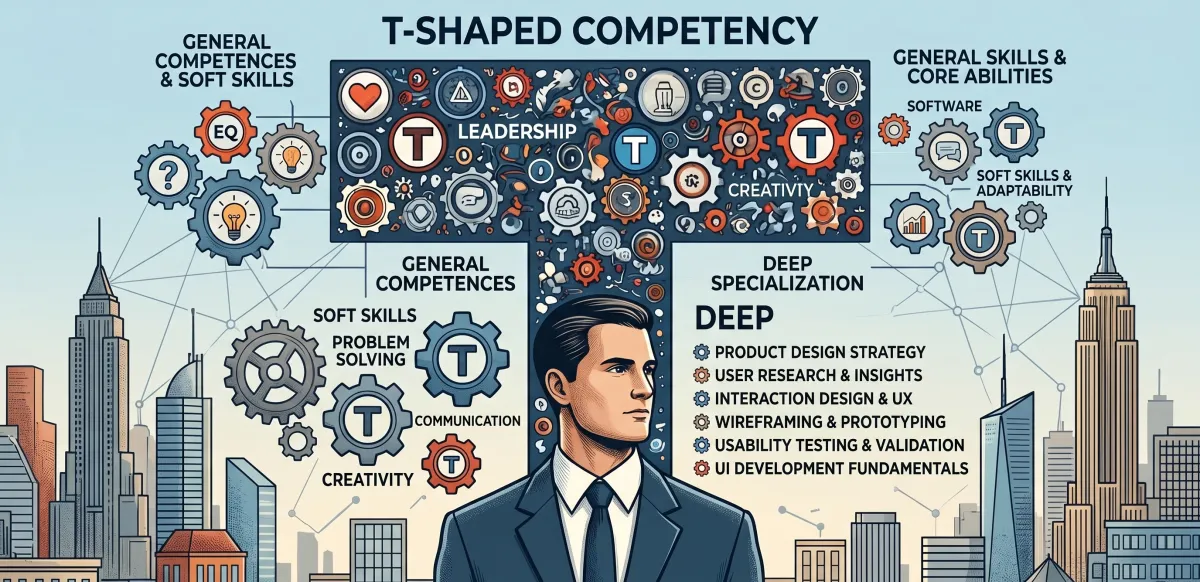
The T-Shaped model describes a professional who carries both vertical depth and horizontal breadth in a single, integrated capability profile.
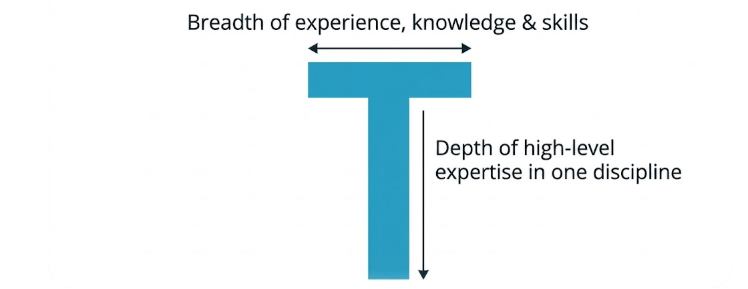
The vertical bar represents Deep Competence, a specific area of functional expertise that earns the practitioner the right to be in the room. In Talent Management this looks like deep fluency in succession planning, learning programme design, talent mobility and pipeline management, or leadership development.
The horizontal bar represents working knowledge across a range of adjacent domains—business acumen, data-driven decision-making, technology and AI fluency, change management, and cross-functional collaboration. None of these need to be mastered at expert level. They need to be understood well enough to ask the right questions, recognise when something is going wrong, and work productively with the specialists who do own them.
The distinction matters because breadth without depth produces generalists who cannot drive outcomes in any specific area, while depth without breadth produces specialists who cannot see how their work ripples across the organisation. The T-shape is the configuration that lets a Talent Management Professional be genuinely useful at the strategic and operational level simultaneously.
Building on this foundation, the Academy of Innovate HR (AIHR) has popularised a sharper articulation of the horizontal bar specifically for HR practitioners. Five horizontal competencies define the modern profile:
Data Literacy— making decisions on evidence, not intuition
Business Insights— understanding strategy, markets, and commercial drivers
AI Fluency— leveraging cognitive technology to scale human impact
Execution Excellence— translating strategy into delivered outcomes
Human-Centric Stewardship— designing experiences that protect dignity and psychological safety
A practitioner with depth alone is a technician. A practitioner with breadth alone is a generalist. The T-Shaped practitioner is something altogether different—an irreplaceable strategic architect.
To see how T-shaped model in practice, let's meet Marcus.
How the T-Shaped Model Works for Marcus
Marcus is a Talent Management Specialist inside a rapidly transforming global enterprise. On paper, his job description reads like any senior HR role: he oversees the end-to-end talent lifecycle, with a focus on learning design, leadership coaching, career frameworks, and internal talent mobility. In practice, the way he operates looks nothing like traditional HR.
When Marcus designs learning journeys, he does not start with course catalogues—he starts with Business Insights. He maps capability gaps against the organisation’s three-year strategy, then engineers curricula that close those gaps in lockstep with where the business is headed. Once the design is set, Execution Excellence takes over: he identifies the right delivery channels, orchestrates flawless deployment across global teams, and holds the entire system accountable to measurable behaviour change.
When the work shifts to building leadership capability, Marcus draws on Human-Centric Stewardship. He designs leadership experiences that deliberately foster psychological safety, recognising that people do not grow inside fear. To scale that impact beyond his own calendar, he applies AI Fluency—deploying cognitive coaching tools and behavioural nudges that reach far more leaders than one human coach ever could.
When succession enters the picture, Marcus refuses to rely on gut feel. Data Literacy lets him identify critical roles, model pipeline risk, and build succession strategies grounded in objective performance signals rather than the comfortable politics of who has been around longest. The career development programmes that emerge from this work are equitable by design and defensible under scrutiny.
When internal talent mobility becomes a strategic priority, Marcus brings all four horizontal competencies into the same project. He stands up an internal talent marketplace powered by AI-driven adjacent-skills mapping (AI Fluency). He uses scenario modelling to forecast emerging workforce requirements (Data Literacy). He removes the administrative friction in transfer policies that traps talent inside silos (Execution Excellence). And he frames the entire initiative as a commitment to the employee’s career, not a corporate convenience (Human-Centric Stewardship).
As a head of section for Talent Management division, Marcus also draws on Leadership Competencies such as Talent Empowerment, coaching their team, and setting clear direction as priorities evolve.
This is what the T-Shaped Model looks like in real working hours. Not a theoretical framework. A daily operating system.
What This Means for You Now?
If you are a Talent Management practitioner reading this and wondering where to start, the answer is more practical than it sounds: expand into the horizontal competency that sits closest to your current vertical expertise.
If your core strength is talent acquisition, your fastest leverage point is evidence-based talent analytics. If your anchor is learning and development, dedicate the next quarter to organisational design and enterprise strategy. If your specialism is total rewards, build genuine fluency in corporate financial modelling. The objective is never to master every discipline. The objective is to build enough cross-functional fluency to participate in high-level conversations, ask the questions others miss, and recognise when external forces are quietly reshaping your domain.
The business case is no longer up for debate. Organisations with mature people analytics programmes are five times more likely to execute rapid, data-backed decisions—and more than three times more likely to financially outperform their competitors. The practitioners driving these results are no longer administrative support. They are the strategic architects defining how their organisations navigate hybrid work, AI automation, and an increasingly volatile global talent market.
Emotional intelligence and human judgement remain the bedrock of our profession. They always will. But the modern landscape demands they now be paired with digital agility, data literacy, and commercial insight. That is the T-Shaped practitioner. And that is the practitioner the boardroom is asking for—the one who closes the gap Gartner identified at the very start of this article.
Your Structured Pathway Forward
Building T-Shaped capability does not happen by accident. It requires intentional, structured exposure to the broader business and a clear framework for how human capital decisions drive enterprise outcomes.
For professionals committed to making this transition, globally recognised credentials provide the proven blueprint. The Talent Management Professional (TMP™) and Senior Talent Management Professional (STMP™) certifications, issued by the Talent Management Institute and delivered in Malaysia through Envolve Alliance as an Authorised Education Provider, are designed precisely for this evolution. They take functional HR specialists and equip them—structurally, behaviourally, and strategically—to operate as indispensable business partners.
Ready to make the move from specialist to strategist?
The next CTMP and CSTMP cohort begins June 2026 in Kuala Lumpur. Seats are intentionally limited so that every participant receives the depth of facilitation this transition deserves.
Envolve Alliance Sdn Bhd is an HRD Corp Accredited Training Provider and the Authorised Education Provider for the Talent Management Institute (TMI) in Malaysia, delivering the CTMP and CSTMP programmes that lead to the TMP™ and STMP™ credentials.